After adopting Power BI, most organizations soon recognize the need for oversight of their analytics environment. They don’t set out to build a DevOps platform for Power BI. They set out to answer simpler, more practical questions:
- What changed?
- Who changed it?
- When did it change?
- And what else did that change affect?
Being able to answer these basic questions is at the core of analytics governance. The challenge in answering these fundamental questions is where many Power BI teams start to struggle, when governance is layered onto generic DevOps platforms.
The Assumption That Creates the Problem
Have you heard this? “We already have Azure DevOps. Let’s just use that.” When Power BI governance becomes a concern, this is the first thought. It feels reasonable. Azure DevOps is already approved. It already supports version control and pipelines. Engineering teams already know it. Why introduce something new?
The problem is that Azure DevOps was never designed for Power BI or analytics workflows. That misalignment shows up quickly once governance, scale, and auditability matter.
Governance Depends on Design, Not Discipline
Azure DevOps is a code-centric DevOps platform. It’s designed for software development. Its workflows assume:
- developers are primary users
- explicit Git commits
- manual check-in and check-out
- scripts and pipelines as the control plane
Power BI development looks nothing like that. Analytics work is visual, iterative, and collaborative. It includes BI developers, analysts, and citizen developers who are focused on models, measures, and insights.
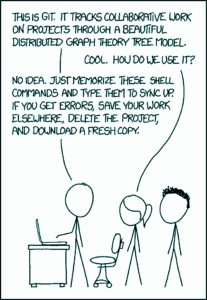
Like the truth portrayed in the XKCD comic, GIT “tracks collaborative work on projects through a beautiful distributed graph theory tree model.” When asked how it works, I hear Nate Bargatze whisper, “Nobody knows.” When governance depends on every user:
- Remembering to commit
- Committing the right artifacts
- Resolving conflicts correctly
- And keeping metadata in sync
Governance becomes optional. With GIT, governance is based on the honor system. No amount of training can change that.
The Hidden Cost Nobody Budgets For
Early implementations of Power BI governance on Azure DevOps sometimes look “good enough.” Version control exists. Pipelines run. Artifacts move between environments. But over time, teams discover what wasn’t planned for:
- ongoing maintenance of scripts and pipelines
- broken or changing Microsoft APIs that require rework
- increasing admin involvement just to keep things stable
- partial version history because not everything gets committed
- gaps in metadata and tenant settings
Azure DevOps requires long-term platform investment that most analytics teams did not plan for. Time and budget spent maintaining pipelines, scripts, and Git workflows do not improve data quality, insight, or decision-making. It keeps the system running, but it does not advance analytics.
Why “Just Use Git” Fails Analytics Governance
Git can manage code. The problem is that Power BI environments are not just code. They include:
- reports and visuals
- semantic models
- tenant settings
- dependencies and relationships that never live cleanly in a repository
Organizations have tried to make a software tool designed for engineering fit analytics governance. Just because something works for software development does not mean that it will work for analytics. Governance is the real requirement and governance must be complete.
When versioning requires manual action, some changes are missed. When some changes are missed, governance is incomplete. When governance is incomplete, teams cannot reliably answer “what changed?”
Most organizations only discover this gap after something breaks. To be fair, that’s not really governance. That’s forensics.
What Production-Ready Power BI Governance Requires
Effective Power BI governance is not about having some controls. It’s about completeness and reliability. Production-ready governance requires:
- Zero-touch version control, capturing changes automatically
- Visual diff, so BI teams can understand impact without reading code
- Complete artifact coverage, including tenant settings
- A comprehensive metadata catalog as a system of record
- Governed deployments with approval and rollback
These capabilities exist within the governance platform itself and are not dependent on manual processes or disciplines. Solving the governance gap requires a platform designed for analytics—not a general-purpose engineering tool..
Staying True to the Core Mission
Most analytics teams are not trying to become DevOps platform teams. Their mission is:
- improving insight
- increasing trust in data
- enabling better decisions
- scaling analytics responsibly
When governance is implemented on a generic DevOps platform, analytics teams quietly inherit a second mission: maintaining the platform that governs them. That shift is rarely intentional, but is almost always costly.
Where Soterre Fits
Soterre is a Power BI-native governance platform, designed specifically around how analytics is created, changed, and deployed. It:
- automatically versions Power BI artifacts without manual intervention
- provides visual diff and granular rollback
- maintains a complete metadata catalog
- captures tenant-level changes for audit readiness
- supports governed deployments through a BI-friendly interface
Most importantly, investment in Soterre directly improves analytics governance through visibility, trust, and control.
The Question That Matters
So, when you hear, “we have it, let’s just use it,” consider the true cost. The real question for analytics leaders is simpler: Do you want your analytics teams investing their time and budget in maintaining a generic platform, or in improving analytics governance itself?
If staying true to your core mission matters, governance needs to be built in, not bolted on. And if governance is about seeing clearly what has changed and why, then Soterre is not just a platform, it’s your salvation.