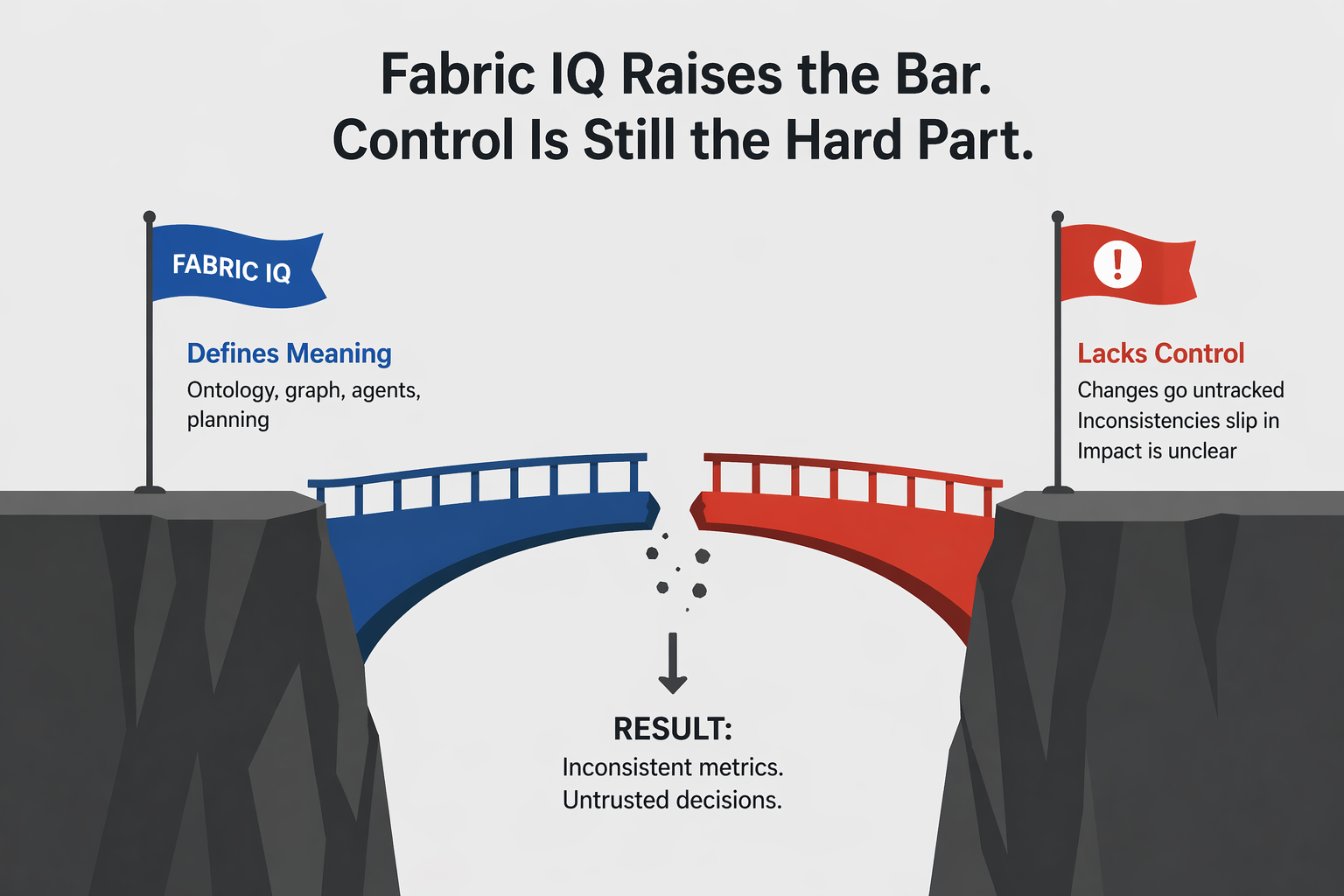
Fabric IQ Raises the Value of Semantic Control. Most Teams Still Lack Operational Control.
Fabric IQ is Microsoft’s emerging semantic and AI framework for consistently organizing business meaning across data, analytics, planning, and AI experiences within Fabric. Microsoft positions Fabric IQ as a preview workload for unifying information across OneLake and organizing it around your shared language of business.
It brings together ontology, graph, agents, planning capabilities, and Power BI semantic models so teams can define concepts once and use them more consistently across analytics and AI experiences.
For data and analytics leaders, that sounds like progress towards a cleaner operating model:
- Define shared business concepts consistently.
- Reduce duplicate logic across teams and reports.
- Ground analytics and AI in the same vocabulary.
That is the right direction.
But it also exposes a harder problem that many organizations have not yet solved: Fabric IQ assumes a level of semantic control most Power BI environments do not actually operate with.
In many environments, changes to logic and dependencies are not consistently governed or validated as Power BI environments evolve. That is the governance problem Fabric IQ surfaces rather than solves.
Fabric IQ raises the expectations for semantic consistency, but it does not remove the operational burden of maintaining control.
Fabric IQ depends on business concepts being modeled clearly enough to reuse across tools and workflows. Microsoft positions this explicitly in its Fabric IQ ontology materials1, where the ontology is described as the semantic foundation that binds data, processes, rules, and actions into a reusable business context. Power BI semantic models can help generate ontology, but the underlying environment still has to support that consistency.
Microsoft’s Fabric IQ documentation also makes it clear that teams still have to validate model relationships, bindings, and business context completeness, with support varying across architectures such as Import, Direct Lake, and DirectQuery. That reinforces a larger point: semantic consistency still depends on the control of the underlying Power BI environment.
The harder problem is often not generating business meaning, but sustaining control over the changes that affect meaning over time:
- Changes to measures, models, and metadata as development continues
- Differences introduced through development or production fixes
- Dependencies between reports and semantic models across workspaces
- Deployment activity and promotion paths that can alter logic across environments
Imagine a developer updates a shared customer classification measure in one model to support a new reporting requirement, but dependent reports in other workspaces continue using the prior logic. All reports still render normally, but teams may now be making decisions based on conflicting definitions from the same customer segment.
The issue is not that the semantic layer failed to define meaning. The issue is that semantic consistency changed over time, and no operational control surfaced the impact.
These are operational realities that do not disappear because a semantic layer sits below them; they become more consequential when more analytics and AI depend on them. Fabric IQ helps define and propagate meaning, but it does not automatically verify that semantic logic remains aligned over time.
Change can introduce breakage, but slowing change is rarely a sustainable solution.
Most D&A leaders do not lose sleep over whether the term “Customer” exists in a business glossary. They lose sleep over whether business logic remains consistent as environments evolve, whether teams can trust what reaches production, and whether growing semantic complexity is introducing risk.
These are the questions governance, platform, and D&A leadership teams eventually have to answer as semantic complexity grows:
- What production measure changed last week?
- Which reports or models depend on that change?
- Where does conflicting or duplicated logic exist?
- What moved into production, and with what impact?
These are not ontology questions. They are control questions.
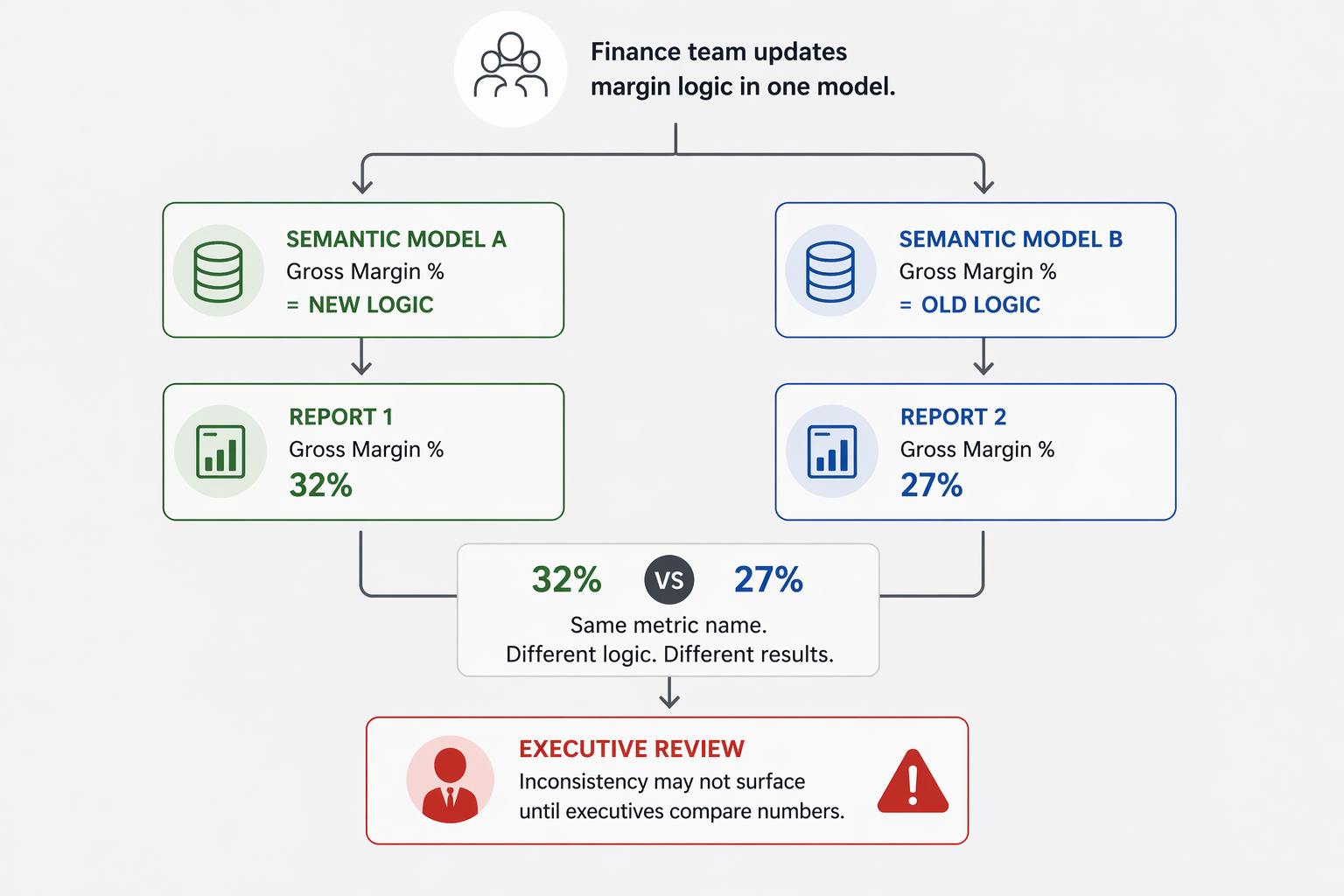
A common expression of this problem is the use of conflicting metric logic. A finance team updates margin logic in one semantic model, while another one keeps an older definition. Both reports still show “Gross Margin %,” but the inconsistency may not surface until executives compare results.
A shared semantic model only remains valuable if teams can sustain consistency as that model evolves over time.
Many environments begin with a shared semantic model, but over time, production fixes, copied models, and independent development paths introduce variation. Model v1 becomes Model v2, while dependent reports and workspaces continue to operate on different logic. Over time, teams optimize locally for speed, delivery, or isolation of risk, even when it introduces long-term semantic divergence.
The problem is not the existence of a shared semantic layer. The problem is losing operational control as that semantic layer changes over time.
Fabric IQ introduces governance at the ontology layer, but those controls differ from the operational controls needed to maintain consistency across the underlying semantic environment.
In well-governed Power BI environments, four characteristics tend to show up:
- Visibility into models and DAX changes over time
- Comparison of changes before promotion
- Understanding dependencies and impact paths across the environment
- Early identification of conflicting or duplicated logic
Without those controls, governance depends on manual discipline and tribal knowledge, an approach that becomes difficult to sustain as self-service growth increases and mistakes become more expensive.
The opportunity Fabric IQ creates.
Fabric IQ is a notable Microsoft launch because it pushes semantic consistency closer to the center of analytics architecture.
If teams cannot clearly determine what changed, understand what those changes affect, or verify that expressions remain aligned across environments, the issue is not simply whether a semantic layer has been adopted.
The question is whether they have real operational control over the semantic layer that ontology, planning, and AI increasingly depend on.
As ontology, planning, and AI agents become more dependent on reusable semantic context inside Fabric IQ, operational consistency becomes more consequential rather than less.
Many organizations believe they have semantic governance because they have adopted shared models, Git integration, or business glossaries. Operationally, those controls are often incomplete once semantic models begin evolving across teams and environments.
That is the broader governance problem Fabric IQ does not remove, but increasingly makes harder to ignore.