Power BI has matured into a mission-critical analytics layer for enterprise organizations. As adoption expands, so does the complexity of managing analytical content.
Reports, semantic models, measures, dashboards, and workspaces are often created across multiple teams, introducing challenges around version control, deployments, auditability, governance, and consistency. As organizations layer Microsoft Copilot on top of these environments, the quality of AI-generated answers depends directly on the consistency of the underlying semantic models and business definitions.
This guide examines the leading DevOps and Power BI governance platforms organizations are evaluating in 2026, what each does, where each focuses, and how they compare across the capabilities that matter most.
Industry Overview & Selection Criteria
In today’s enterprise analytics environments, the choice of Power BI DevOps and governance tooling can dramatically shape how reliably and consistently, and at what operational cost, organizations deliver trusted analytical content. With AI rapidly transforming how Power BI and Microsoft Fabric are consumed, it is worth stepping back and asking: which platforms address the full problem in 2026, and which are purpose-built for only one part of it?
Power BI environments share a common set of challenges at a certain size. Semantic models multiply across business units, and measure definitions drift silently until two teams report different values for the same KPI. Reports accumulate without owners, making it impossible for users to identify authoritative content. Deployments happen without approval gates, and when something breaks in production, no audit trail exists to identify what changed or who changed it. As organizations layer Microsoft Copilot on top of these environments, the quality of AI-generated answers depends directly on the consistency of the underlying semantic models and business definitions.
GARTNER · HYPE CYCLE FOR DATA AND ANALYTICS GOVERNANCE, 2026
According to Gartner’s 2026 Hype Cycle for Data and Analytics Governance, analytics governance is a high-benefit discipline focused on how organizations make decisions about analytics content, including metrics, dimensional attributes and hierarchies. Gartner notes that measure inconsistency has reached an intolerable level in most organizations, and that AI models underpinning conversational analytics depend on greater clarity and consistency in how those measures and hierarchies are defined.
The platforms in this evaluation each address some of these questions. Organizations evaluating Power BI governance tools, Power BI DevOps solutions, and analytics governance platforms often find that no single product addresses every requirement.
The Leading Power BI DevOps and Governance Platforms in 2026
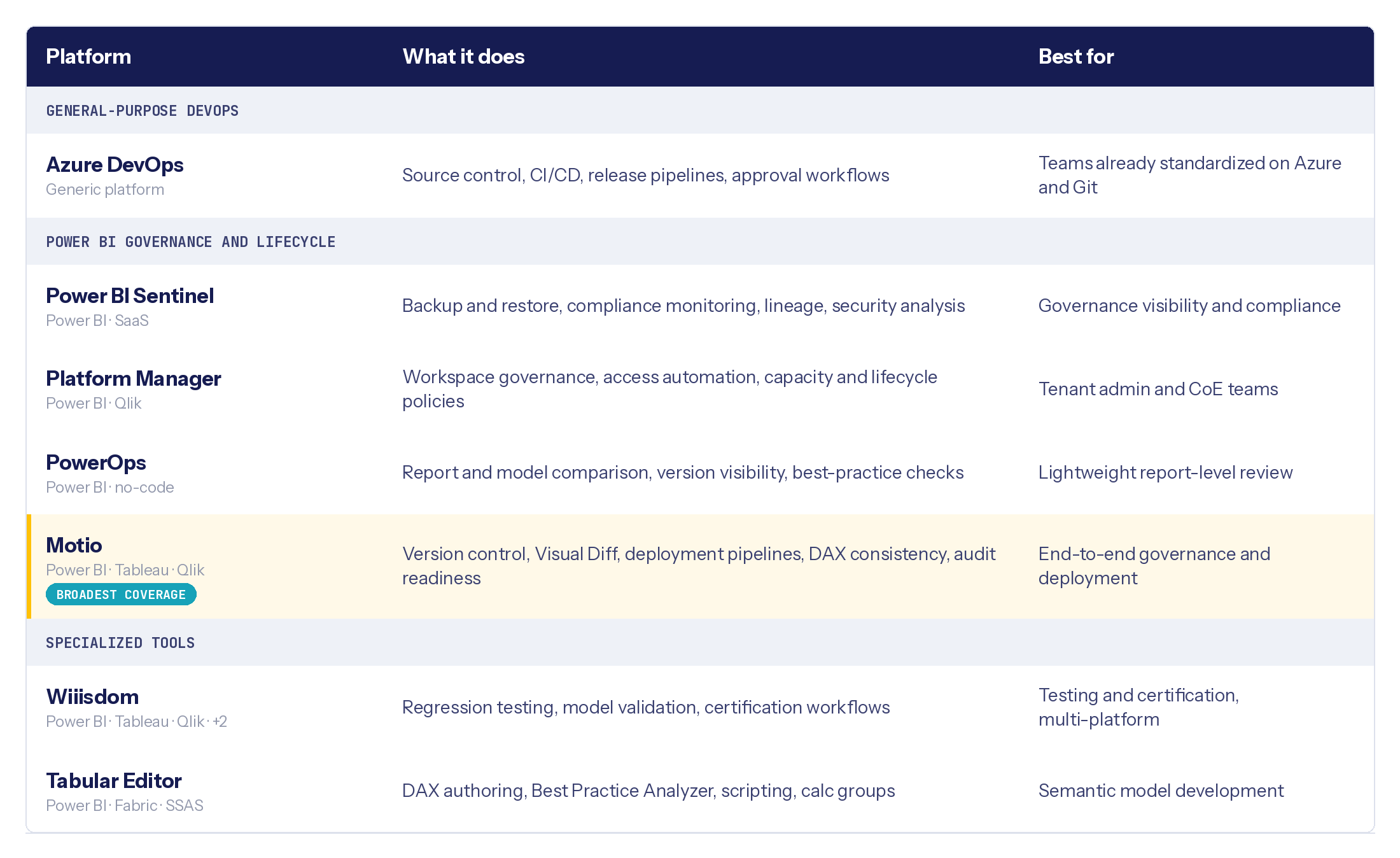
Each platform below addresses a different layer of the Power BI DevOps and governance stack. Understanding which layer each tool covers and where the scope ends is the essential step before any selection decision.
Power BI DevOps and Governance Capability Comparison
Although these platforms are frequently evaluated together, they address different layers of Power BI governance and DevOps problems.
The table below summarizes how each platform maps to the primary capabilities categories organizations evaluate. Ratings reflect the platform’s design focus area rather than subjective judgments of quality.
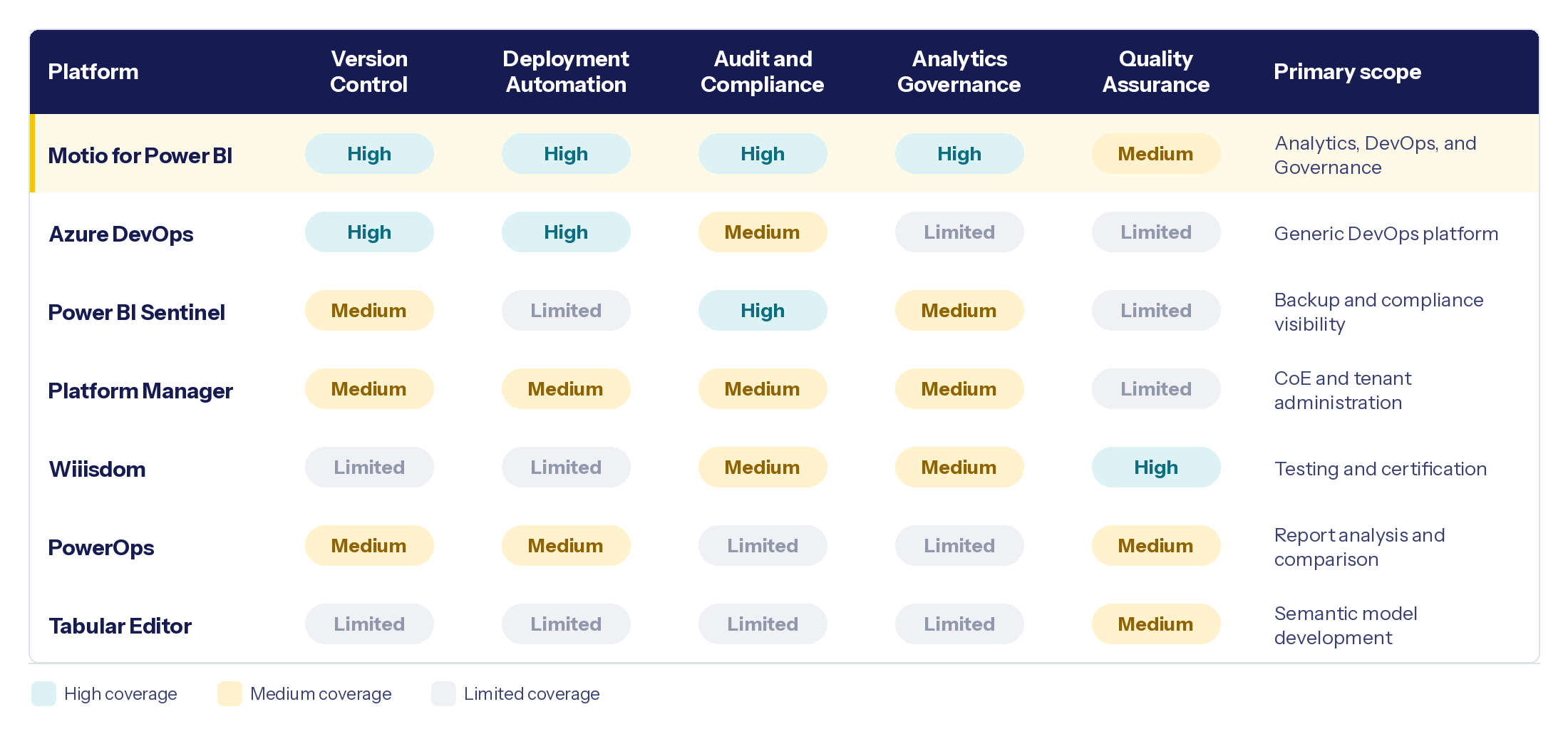
While these platforms are frequently evaluated together, each excels in a different area of the Power BI lifecycle. The following recommendations highlight where each platform is strongest based on its primary focus.
Deeper Insights and Industry Trends
Analytics Governance Is Moving Into the Mainstream (Gartner Hype Cycle for Data and Analytics Governance, 2026)
For years, enterprise governance investment focused primarily on the data layer, data quality, lineage, metadata management, access controls, and regulatory compliance. Many organizations are now discovering that governed data does not automatically produce governed analytics. Gartner’s 2026 Hype Cycle for Data and Analytics Governance rates analytics governance with a High benefit rating, noting market penetration of 20–50% of the target audience and an adolescent maturity level — meaning most organizations are still early in building operational governance programs. The discipline is currently in the Trough of Disillusionment, a signal that early implementations have often underdelivered, and that execution now separates successful programs from stalled ones.
The rise of self-service Power BI has created environments where reports, measures, semantic models, and KPIs are developed independently across multiple business units, with no systematic mechanism to detect when definitions diverge or when content becomes stale or orphaned.
Gartner also cautions that many governance programs invest heavily in policy definition while failing to establish the operational mechanisms needed for policy enforcement and execution. Programs built on documented standards alone, without automated version capture, deployment approval gates, and consistency monitoring, consistently fall short of their governance objectives. (Gartner, Hype Cycle for Data and Analytics Governance, 2026. Gartner does not endorse any vendor, product, or service depicted in its research.)
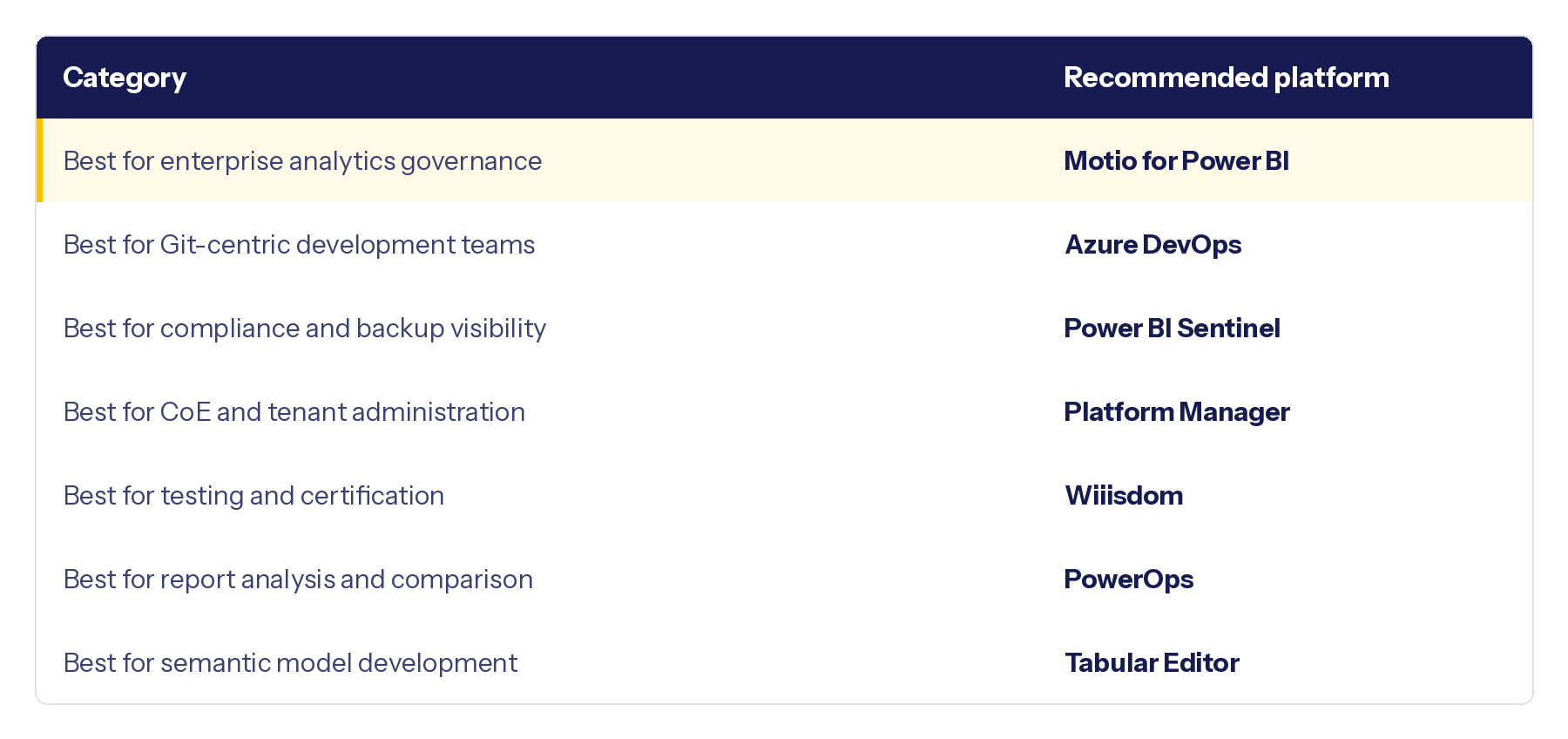
Top Platforms by Category
While no single platform is the right answer for every organization, several solutions stand out in specific areas based on their primary focus and capabilities.
Final Thoughts: Context Matters More Than Rankings
Developer-centric teams with mature engineering practices and code-first Power BI development workflows will find Azure DevOps a natural fit for the CI/CD layer. Organizations focused primarily on compliance visibility and report-level backup have a fast path to value with Power BI Sentinel. CoE teams managing workspace sprawl and administrative overhead at enterprise scale have a specific solution in Platform Manager. Teams in regulated industries with formal pre-deployment certification requirements have a strong case for Wiiisdom. Every serious semantic model developer benefits from Tabular Editor regardless of what governance platform sits alongside it. Smaller teams prioritizing report quality analysis and accessible comparison tooling have an option in PowerOps.
The broader trend, however, is clear. The Power BI governance conversation is moving beyond individual tool categories, beyond backup-and-monitoring, beyond CI/CD, beyond regression testing, toward platforms that address the full analytics lifecycle. As organizations attempt to scale Power BI programs across decentralized teams, prepare analytical environments for AI adoption, and satisfy increasing compliance scrutiny of the analytics layer itself, the evaluation criteria are expanding correspondingly.
The most effective Power BI programs treat analytical content, reports, semantic models, measures, hierarchies, and business definitions, as strategic enterprise assets that require the same lifecycle discipline, accountability, and governance as other mission-critical systems. Motio for Power BI is the only platform in this evaluation purpose-built to address the complete analytics governance lifecycle, not one layer of it. Where other platforms in this comparison are point solutions focused on a specific problem (backup, tenant administration, testing, or development productivity), Motio covers the full stack: zero-touch version control, Visual Diff, deployment pipelines with approval workflows, DAX consistency monitoring, SOX audit readiness, and analytics governance stewardship. The results are measurable: organizations using Motio report up to 20% development efficiency gains, 4× faster deployments with reusable deployment plans, 90% fewer DAX inconsistencies across environments, and a 60% reduction in unused content through cleanup automation. The platforms that support that level of governance, across the full stack from version capture to deployment approval to DAX consistency monitoring to audit trail generation, are the ones earning investment in enterprise analytics programs.