Overview / Summary
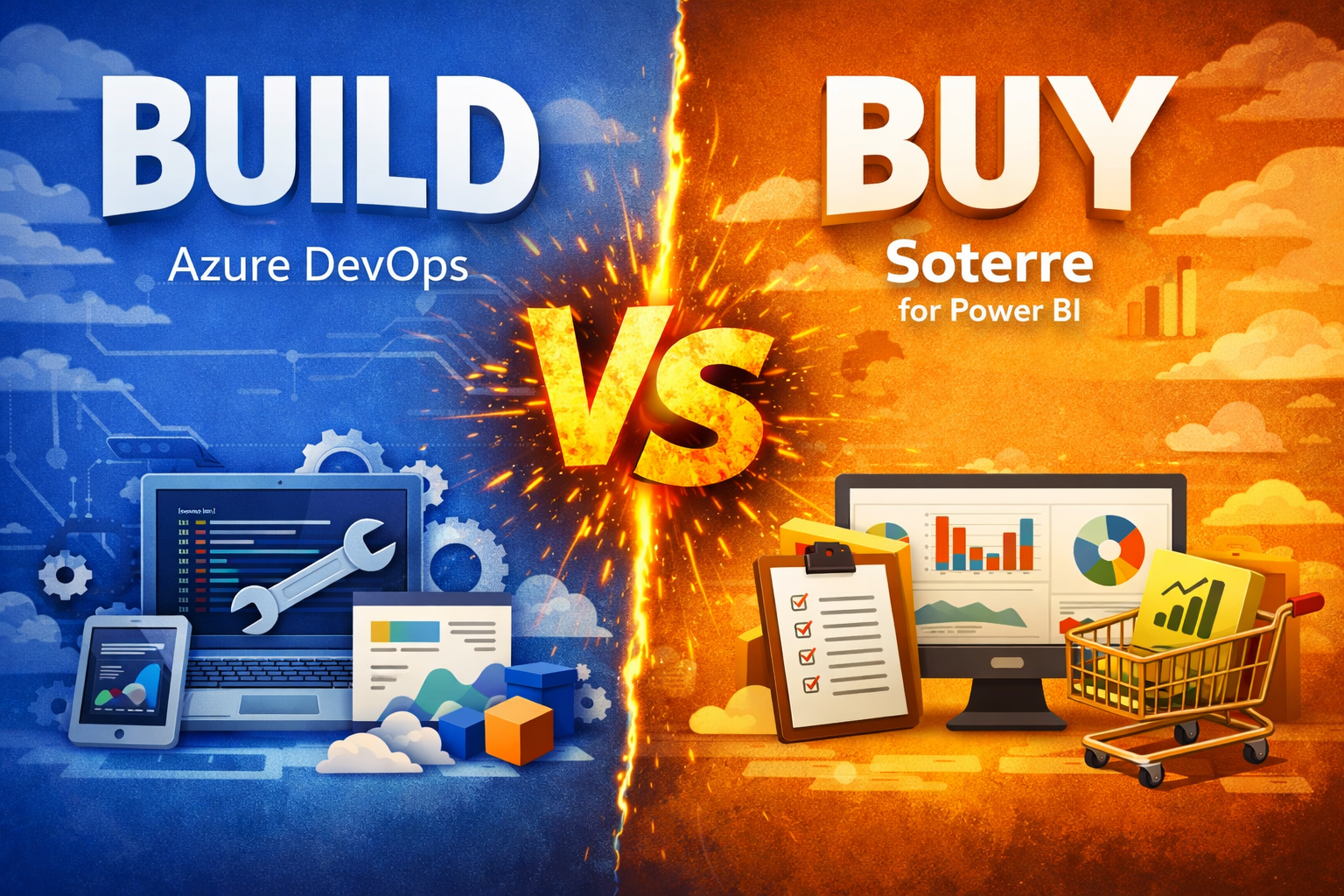
Soterre and Azure DevOps represent two fundamentally different approaches to managing Power BI deployments and governance. Soterre is a purpose-built analytics governance and version control platform designed specifically for Power BI environments, while Azure DevOps is a general purpose DevOps platform that can be adapted for analytics through custom pipelines, scripts, and processes.
This article compares Soterre and Azure DevOps through a buy vs. build lens, focusing on time-to-value, setup effort, ongoing maintenance, governance capabilities, scalability, and long-term risk. It is intended for Power BI teams, BI managers, and enterprise organizations evaluating whether to purchase a dedicated analytics governance solution or invest in building and maintaining custom DevOps workflows. The goal is to help teams make a clear, informed decision based on operational reality rather than tooling familiarity alone.
Why Power BI Teams Face the Buy vs Build Decision
As Power BI environments grow, clicking publish carries more risk and coordination.
What starts as a few reports often turns into multiple workspaces, environments, developers, and stakeholders, leading to expectations around governance, reliability, and auditability. At that point, teams reach a familiar decision point. Do we build Power BI deployment workflows ourselves using existing DevOps platforms, or do we buy a solution designed specifically for analytics?
Azure DevOps often enters the conversation because many organizations already use it. Soterre enters the conversation because Power BI teams realize they are now running production systems, and not experiments, and they need tooling built for that level of responsibility.
What Is Soterre
Plain English definition
Soterre is a Power BI governance and version control platform built specifically to manage, track, compare, and deploy Power BI assets safely across environments.
Technical definition
Soterre provides automated version control, environment comparison, controlled deployments, and governance auditing for Power BI tenants and workspaces without requiring custom scripting or pipeline maintenance.
What Is Azure DevOps
Plain English definition
Azure DevOps is a general purpose platform used to manage software development through repositories, pipelines, and automation. It is built mainly for software engineers and technical teams, with strong ties to languages like C#.
Technical definition
Azure DevOps can be adapted to support Power BI deployments by using Power BI APIs, PowerShell scripts, service principals, and custom CI/CD pipelines designed and maintained by internal teams.
Core Differences Between Soterre and Azure DevOps
At a high level, the difference is not feature-based. It is philosophical.
Purpose and Design Philosophy
- Soterre is designed specifically for analytics governance and Power BI lifecycle management
- Azure DevOps is designed for application development and must be extended to work for BI
Time to Value
- Soterre delivers value quickly with minimal setup
- Azure DevOps requires design, scripting, testing, and iteration before delivering value
Ownership and Maintenance
- Soterre is vendor-managed and supported
- Azure DevOps pipelines are owned, maintained, and debugged internally
Governance and Risk
- Soterre includes built-in auditability and change tracking
- Azure DevOps governance depends entirely on how well pipelines are built and enforced
Soterre vs Azure DevOps Comparison Chart
| Category | Soterre Buy | Azure DevOps Build |
| Primary purpose | Power BI governance and version control | General purpose DevOps tooling |
| Designed for analytics | Yes | No |
| Time to value | Fast | Slow |
| Initial setup effort | Low | High |
| Ongoing maintenance | Vendor managed | Internally managed |
| Deployment workflow | Guided and controlled | Custom scripts and pipelines |
| Version control | Native Power BI object tracking | Custom implementation |
| Environment comparison | Built in | Script dependent |
| Governance and auditing | Automatic | Manual or custom |
| Knowledge silos | Low | High |
| Scalability | Designed for enterprise | Complexity increases over time |
| Cost model | Predictable licensing | Hidden labor and maintenance costs |
| Long-term risk | Lower | Higher |
| Best for | Teams needing reliable governance | Teams willing to build and maintain |
Table summary
Soterre offers a purpose-built, lower-risk approach to Power BI governance, with faster time-to-value and predictable ownership. Azure DevOps provides flexibility through custom pipelines but requires significant engineering effort and ongoing maintenance as environments scale.
How the Buy vs Build Decision Plays Out in Practice
Building with Azure DevOps
When teams choose Azure DevOps, they are committing to a custom engineering effort rather than a configuration exercise.
This typically includes the following responsibilities.
- Designing Power BI deployment logic
- Writing and maintaining PowerShell scripts
- Managing service principals and permissions
- Handling edge cases and deployment failures
- Updating pipelines as Power BI APIs change
Over time, these pipelines become critical infrastructure and increasingly fragile if key knowledge lives with only a few individuals.
Buying with Soterre
Buying Soterre shifts responsibility away from internal engineering teams.
Teams gain the following benefits.
- Pre-built Power BI workflows
- Consistent deployment patterns
- Centralized governance visibility
- Vendor support and ongoing updates
Instead of asking how to build this, teams focus on how to operate more effectively.
Pros and Cons Comparison
Soterre
Pros
• Purpose-built for Power BI
• Faster onboarding
• Reduced operational risk
• Strong governance and auditing
Cons
• Requires licensing investment
• Less flexible than fully bespoke pipelines
Azure DevOps Build Approach
Pros
• Uses existing DevOps tooling
• Highly customizable
• No additional software procurement
Cons
• High setup effort
• Long-term maintenance burden
• Knowledge silos
• Increased governance risk
When Azure DevOps Makes Sense
Small or Experimental Power BI Environments
Azure DevOps can be a reasonable choice when the following conditions apply.
- Power BI usage fits team size and report volume.
- Governance requirements are minimal
- Strong engineering resources are available
- Long-term scalability is not a primary concern
When Soterre Makes Sense
Enterprise Power BI Teams
Soterre is typically the better option when the following conditions exist.
- Multiple environments such as development, test, and production
- Auditability and compliance requirements
- A need for predictable and repeatable deployments
- A desire to reduce operational and delivery risk
Common Misconceptions About Buy vs Build
We Already Pay for Azure DevOps So It Is Free
Azure DevOps licensing may already exist, but engineering time, ongoing maintenance, and operational risk still carry real costs.
We Can Just Script This Once
Power BI APIs, business requirements, and environments change over time. Scripts require continuous upkeep whether teams plan for it or not.
How AI and Modern Analytics Increase Buy Side Value
As analytics becomes more deeply embedded in business decision-making.
- Deployment mistakes carry higher consequences
- Governance expectations increase
- Manual processes become harder to justify
- Auditability becomes essential
Purpose-built analytics governance tools increase in value as tolerance for risk decreases.
Key Takeaways
- Soterre and Azure DevOps address different needs
- Azure DevOps represents a build path rather than a turnkey solution
- Soterre reduces long-term operational overhead and risk
- Buy vs build decisions should include maintenance costs
- Power BI governance complexity increases as environments scale
Frequently Asked Questions
Can Azure DevOps replace Soterre for Power BI
Azure DevOps can support Power BI deployments through custom pipelines, but it does not provide built-in governance and visibility in the same way as Soterre.
Is Soterre only for large enterprises?
While enterprises benefit most, any team with growing Power BI complexity can benefit from purpose-built governance.
How long does it take to build Power BI pipelines in Azure DevOps
Initial pipelines often take weeks or months to design and implement, followed by ongoing iteration as requirements evolve.
Does Soterre work with existing Power BI tenants
Yes. Soterre integrates with existing Power BI tenants and workspaces.
Which option is lower risk long-term
Purpose-built platforms like Soterre generally reduce long-term operational risk compared to custom-built solutions.
Final Thoughts
The Soterre vs Azure DevOps decision is not about good versus bad. It is about intent.
Azure DevOps is a powerful general-purpose platform. Soterre is a focused analytics governance solution. The right choice depends on scale, risk tolerance, and how much internal effort a team is prepared to own over time.
For many Power BI teams, the real question is not whether they can build this, but whether they should.